
Author: Andrey Razumov.
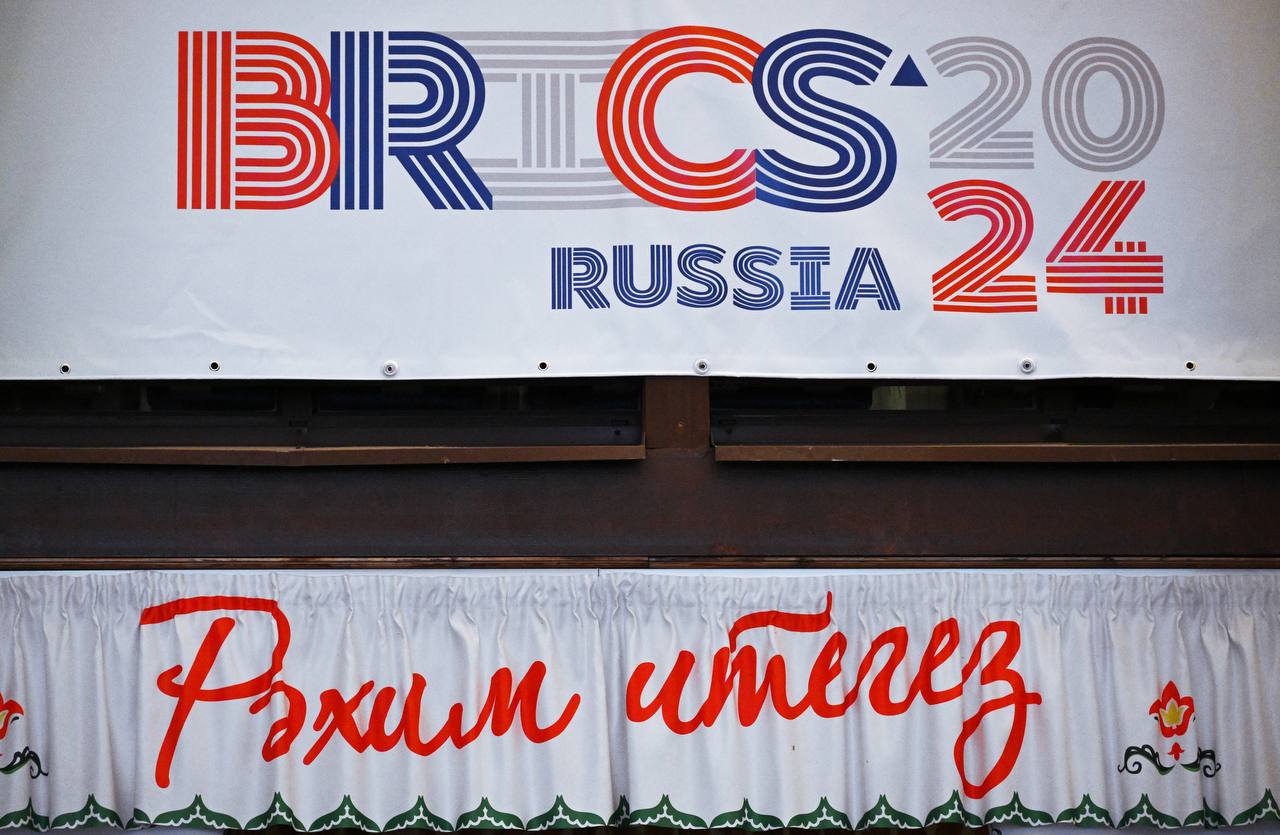
The BRICS summit held in Kazan forced the world to once again revise international relations and their development strategy. The system of international blocs and alliances is again and again being tested for sustainability in a rapidly changing political and economic environment. First of all, the storm raised by the Kazan summit affected transatlantic and intra-European unions.
The BRICS countries account for 45% of the world’s population, and their share in global GDP at purchasing power as of the end of 2024 was 36.7%. This year, Russia chairs the association under the motto «Strengthening Multilateralism for Equitable Global Development and Security.» In 2025, the presidency will pass to Brazil.
In total, delegations from 35 countries and six international organizations took part in the summit in Kazan. A brief summary of the three-day meetings, briefings, and sessions is the following. The BRICS countries advocated a multipolar world order. The states called for strengthening the non-proliferation regime and a nuclear-free zone in the Middle East. The countries are concerned about the growing violence and ongoing armed conflicts in various regions of the world and reaffirmed their commitment to the peaceful settlement of disputes through diplomacy, mediation, comprehensive dialogue and consultations. BRICS members called for an immediate ceasefire in Gaza, the release of all hostages without preconditions and condemned Israeli attacks on humanitarian points and infrastructure in Palestine. BRICS countries stressed the need to resume the Iran nuclear deal. The declaration recalls national positions on the situation in Ukraine and notes «proposals for mediation and good offices aimed at ensuring a peaceful settlement of the conflict through dialogue and diplomacy.» Following the expanded meeting, Vladimir Putin also declared the economic superiority of the BRICS countries over the G7.
These and other statements triggered a wave of comments from American and European experts. Some of them doubted the effectiveness of BRICS, calling the bloc both a «house of cards» and a colossus with feet of clay. However, most of them, one way or another, note that BRICS is becoming more attractive to an increasing number of states that do not want to «put all their eggs in one basket.» The basket obviously refers to a system of international alliances and unions in which the dominant role belongs to the United States or the European Union.
Of course, it is incorrect to compare BRICS and, for example, the European Union. Unlike the EU, the BRICS countries do not have mutual obligations, BRICS does not have a charter, regulations or any clear rules, but they do have common political and economic interests and ideas about the world order — this is what attracts interest to the union.
At the same time, BRICS is a logical part of one big puzzle of the chain that is forming on the pan-continent: BRICS – SCO – EAEU. One can have different attitudes to the efficiency of these associations: there are enough contradictions, integration is not as fast as many participants, first of all, Russia, would like. But against the background of intra-European economic and political cooperations – the Lublin Triangle or the Three Seas Initiative – BRICS – SCO – EAEU looks like dynamically developing and proactive associations. Why is this happening? There are several reasons for the degradation of European initiatives.
One of them can be seen, oddly enough, in the imperial ambitions of a number of EU members and their desire to play a bigger role in the EU than they have now. Thus, at the start of the Three Seas Initiative project, experts pointed to the historical roots of Poland’s ambitions to influence European politics by creating a greater Poland «from sea to sea» if not in territorial borders, then in the borders of geopolitical influence. Since then, the Initiative has not gone beyond three meetings at the level of heads of state and heads of foreign ministries. The last of them, in the spring of 2024, was held in Vilnius and was used, first of all, as a platform for speeches by Ukrainian President Volodymyr Zelensky. On the one hand, this is quite expected — Warsaw is carefully trying to patronize Kyiv, maximally demonstrating its strategic plans to consolidate its influence in Ukraine in the post-war period. On the other hand, initially conceived as a project of interregional dialogue, the Three Seas Initiative is finally becoming a geopolitical project of specific states. Exactly the same can be said about the Lublin Triangle, whose members — Poland, Lithuania and Ukraine — are initially in unequal relations with each other. Since the founding of the Triangle in 2020, the situation of unequal partnership has only worsened.
Generally speaking, intra-European contradictions, fueled by the ambitions of individual EU members and multiplied by military actions in the center of Europe, have led to a unique situation with most European regional unions and alliances. Almost every one of them has lost its originally declared essence and degenerated into platforms with a specific image of the enemy. The enemy, of course, is in the east.
However, no one within the EU denies that the main thing is victory over Russia. And yet, de facto in the near and medium term for the European Union, we are talking about something else: the struggle for the post-Ukrainian space (within the state or intra-regional political or economic unions) and the redistribution of influence within the European space. No official will say this out loud at the Lublin Triangle or Three Seas summits — but this is exactly how the «European» way of thinking looks now behind the scenes.
The European Neighborhood Policy obviously needs a hard reboot, with the removal of the enemy image from the «working code». In the high competition of international associations, European intra-regional blocs and the EU itself, with the initial starting conditions that were once laid down by the founding fathers of the Euro- family, are starting to noticeably lose to BRICS — SCO — EAEU.
Do Euro-bureaucrats and politicians realize this? This is not an idle question. But perhaps the fate of the real European future is being decided right now.





Станьте первым комментатором